
Dig safe
Working safely should be the top priority on every project, large or small. Don't cut corners: have the private lines marked so everyone leaves the job site safe.
Private utility locating · 50 states and D.C.
811 marks public utility lines up to the meter. Everything on your side of the meter is yours: water and sewer laterals, power to pools and shops, gas to grills, irrigation and fiber. Find a private locator in your state to mark them before you dig.
Your state's One Call center sends utility companies to mark their public lines up to the meter. It's free.
Sprinklers, pool power, sewer laterals, gas to grills and lines to shops belong to the property owner.
GPR and EM equipment find metal and plastic lines and mark them on the ground before you dig.
What 811 doesn't mark
On most properties, the lines installed by the owner, a builder or a contractor after the meter are private. They are the lines most often hit by fence, deck, pool, landscaping and solar projects.
Power to pools, hot tubs, detached garages, shops, gate operators, landscape and parking lot lighting, EV chargers and standby generators.
Lines from the meter to grills, fire pits, pool heaters, generators, outdoor kitchens and detached buildings.
Fiber, data and low-voltage cable between buildings, and wiring for security cameras, alarms and gates.
The service line from a curbside meter to the house, private fire lines and hydrants, and lines to barns and outbuildings.
Sprinkler mains, lateral lines and zone valve wiring, which are often shallow and run across the whole yard.
Sewer laterals to the street, septic tanks and drain fields, storm drains and buried downspout lines.
Reading the marks
Public and private locators use the same APWA uniform color code, so marks look the same no matter who placed them. Lines are shown with paint, flags or both.
Marks show the approximate location of a line, not its exact position or depth. Dig by hand near any mark, and check your state's 811 center for the required clearance.
A private utility locator is a company you hire to find and mark the buried lines on your property that 811 member utilities don't mark. The work is done with the same kinds of equipment the utilities use, plus tools made for lines that are hard to trace.
Most metal lines and tracer wires are found with an EM transmitter and receiver. The locator connects the transmitter to the line at a meter, valve or riser, or induces a signal into it from the surface, then walks the route with the receiver and paints the path. EM locating is fast and accurate on electric, gas lines with tracer wire, metal water pipe and communication cable.
GPR sends radar pulses into the ground and records what reflects back. It can pick up plastic and concrete pipe, abandoned lines and other buried objects that carry no signal. How deep it can see depends on the soil: dry, sandy soils work well, while wet clay can limit it to a shallow depth. That is why a good locator uses GPR alongside EM, not instead of it.
Sewer laterals and drain lines are often clay, cast iron or plastic with no tracer wire. A locator can push a camera or a small transmitter called a sonde through the pipe from a cleanout and follow it from the surface, which also shows the depth and the condition of the pipe.
On a typical job the lines are marked on the ground with paint or flags in the standard colors. For larger commercial and engineering projects, many locators also provide a sketch, a GPS map or CAD files so the results can be used in design and kept for later work.
Who hires a private locator
Before a fence, deck, pool, patio, tree, mailbox or garden goes in, and before hiring someone to dig.
Fence, landscape, irrigation, plumbing, electrical, solar and EV charger installers who need to protect crews and avoid repair bills.
Subsurface utility engineering (SUE) and utility mapping for site design, often to ASCE 38 quality levels.
Clearing locations for soil borings, monitoring wells, geotechnical testing and directional boring.
Campuses, plants, schools, hospitals and multi-family properties with private networks that 811 never marks.
Renovations and additions on developed sites where old, undocumented and abandoned lines are common.
Quick tips
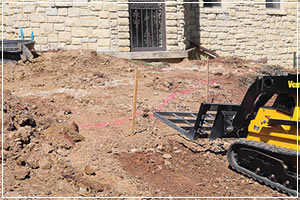
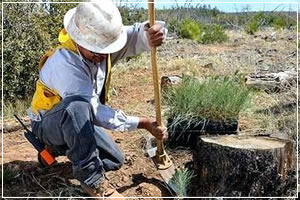
Calling 811 is free. Your state's One Call center notifies its member utilities, and they mark their public lines up to the meter. It does not cover lines installed on private property after the meter, which are the owner's responsibility. Private utility locators use ground penetrating radar (GPR) and electromagnetic (EM) equipment to find those lines: power to pools and outbuildings, water and sewer laterals, irrigation, gas to grills and heaters, communications conduit, storage tanks and other buried features.
Private utilities are the buried lines after the meter or main line. If your meter is at the curb, the line from the meter to your house is private and will not be marked by 811 member utilities. Other lines that usually are not marked include sewer laterals, private lighting, sprinklers, fire mains, power to detached garages and septic lines.
No. Private locating companies charge a service fee. The private lines belong to the property owner, so the owner covers the cost of locating them. Price depends on the size of the area, how many utilities need to be found, the equipment needed and travel. Request a price quote to compare.
Stop digging near it and contact your state's 811 One Call center. They will ask member utilities to check whether the line is theirs. If no member utility claims it, it is a private line and will need to be traced by a private utility locator. If you damage a line or smell gas, move away and call 911.
Yes. In every state you must contact 811 before you dig, even when a private locator is coming. 811 gets the public lines marked for free, and the private locator marks the rest, so you need both to see everything that is buried on the site.
Often, yes. Plastic pipe can be found with ground penetrating radar, by tracing a tracer wire if one was installed, or by pushing a small transmitter (a sonde) or camera through the pipe. No method finds every line in every soil, so locators combine methods and you should still dig carefully by hand near any mark.
Choose your state from the list at the top of this page, the Search by State map, or the state links below. Each state page lists the private locators who serve that state, with a phone number and a quote request button, plus the 811 center for the state.
List your company on your state's page and get web quote requests and calls from homeowners, contractors and engineers who need lines marked.